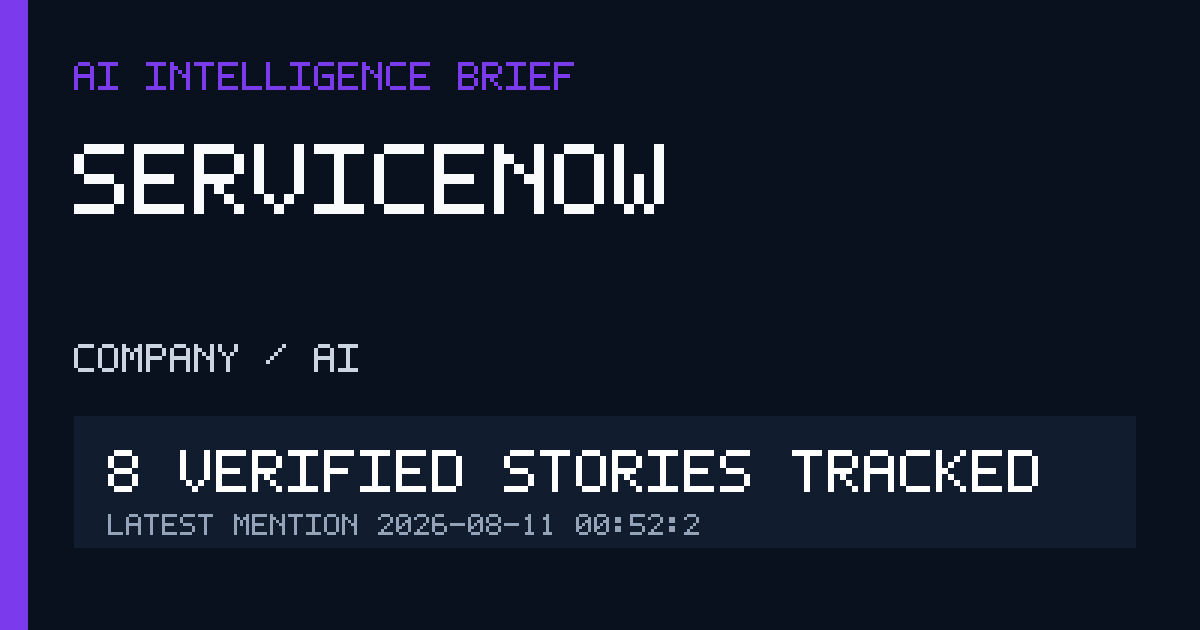
Of the tracked stories, 4 of 8 also mention Salesforce, the most common co-covered peer. The clearest coverage concentration is ai-models: 5 of 8 stories, with the rest divided among 3 other categories. Negative sentiment reaches 0% here, compared with 22% across the 2049-story beat baseline for the same window.
Figures are computed live from our source-verified story record
— see our methodology for how impact and
sentiment are derived.
What the coverage shows about ServiceNow
Of the tracked stories, 4 of 8 also mention Salesforce, the most common co-covered peer. The clearest coverage concentration is ai-models: 5 of 8 stories, with the rest divided among 3 other categories. Negative sentiment reaches 0% here, compared with 22% across the 2049-story beat baseline for the same window. Each story carries 3.8 original sources on average, compared with 2.9 for the broader beat in this window. Across a 172-day span, the pace is roughly 0.3 stories per week. The 6.3 average consequence score is below the beat benchmark of 6.6 in the same window. We currently track 8 AI stories that mention ServiceNow, published between February 18, 2026 and August 8, 2026.
Stories tracked
8
Per week
0.3
Negative
0%
Sources per story
3.8
Computed from the 8 stories linked to this entity, with beat comparisons drawn from all 2049 AI stories published in the same date window. Shares are omitted below five stories and comparisons below a twenty-story baseline.
Coverage cohort
Appears alongside
Other entities that clear the same relevance threshold in stories also covering ServiceNow. Shared-story counts are live from our verified record — not editorial picks.
Tenable's AI Exposure module has detected 457 million security issues across 7,000 organizations, highlighting the scale of risk in enterprise AI adoption. The platform now covers all major LLMs, MCP deployments, and AI-native developer tools, providing automated remediation through its Hexa AI engine. This positions Tenable as a critical infrastructure layer for responsible AI at scale.
Despite a 23% surge in adjusted net income, Microsoft shares have retreated nearly 33% over the last five months as investors weigh the disruptive potential of AI agents against traditional enterprise software models. Bank of America has reinstated a 'Buy' rating with a $500 price target, arguing that Microsoft’s dual-threat position in cloud infrastructure and software applications makes it a rare bargain.
While investors fear AI will cannibalize the SaaS sector through seat-count reduction and custom-built solutions, ServiceNow is positioning itself as an essential 'system of record' for the AI era. By integrating agentic AI and shifting toward consumption-based pricing, the company aims to turn potential disruption into a structural growth driver.
Benchmark's Bill Gurley and NYU's Scott Galloway are signaling a major market rotation, warning that the current AI infrastructure boom may be a bubble. They argue that investors should pivot toward "beaten-down" Software-as-a-Service (SaaS) leaders like ServiceNow and Salesforce, which own the critical enterprise data required for the next phase of agentic AI.
While Palantir Technologies continues to dominate the AI software market with triple-digit commercial growth, its sky-high valuation is driving investors toward established SaaS giants like ServiceNow and Salesforce. These legacy players are aggressively integrating generative AI into their workflows, offering a more value-oriented entry point into the enterprise AI transition.
Taiwan Semiconductor Manufacturing (TSM) and ServiceNow (NOW) are positioned as critical pillars for the AI economy over the next 24 months. While TSM dominates the hardware foundry market for high-performance GPUs, ServiceNow is leveraging its 'system of record' status to lead the transition toward agentic AI workflows.
The cloud software sector is undergoing a valuation recalibration as Salesforce, Oracle, Adobe, and ServiceNow race to monetize generative AI. While Salesforce pivots toward autonomous agents with Agentforce, Oracle leverages its infrastructure dominance to capture enterprise AI workloads, creating a divergent landscape for investors.
Mistral AI's acquisition of cloud startup Koyeb and Palantir's aggressive expansion into enterprise AI platforms signal a major transition in the software industry. Mistral CEO Arthur Mensch predicts that over 50% of enterprise software will eventually switch to AI-native architectures, intensifying the competition for platform supremacy.
ServiceNow is linked from 8 stories on this site, each scored at or above our 35% relevance threshold — see how these pages are built.
See something wrong on this page — a misattributed entity, a wrong stat, a broken source
link? Report a data issue.